
The Apartheid Museum is acknowledged as the pre-eminent museum in the world that focuses on South Africa’s Apartheid era.
Visitors receive a comprehensive education on important South African history with exhibits that include provocative film footage, photographs, text panels and artefacts illustrating the events and human stories that are part of that horrific period of our history.
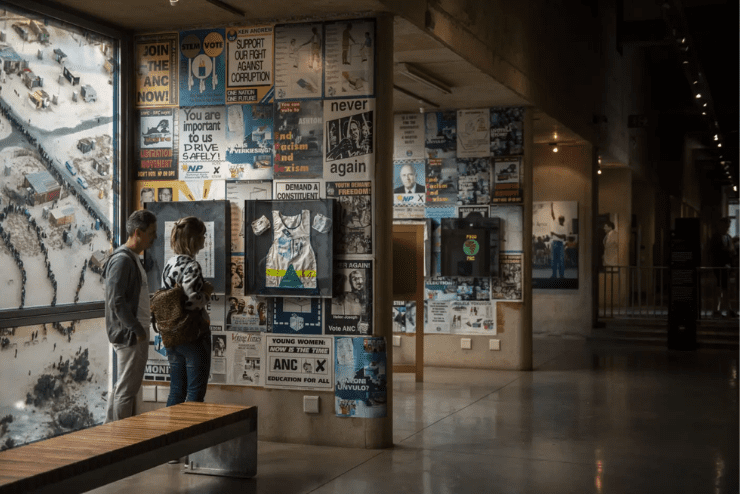
Revisit history at the Apartheid Museum
Having opened in 2001, the Apartheid Museum exhibits have been assembled and organised by a multi-disciplinary team of curators, filmmakers, historians and designers.
The Museum features permanent exhibitions that trace this history from its very beginnings to the post-democratic period. Every so often they also put together temporary exhibitions that delve a bit deeper into important figures or events from the Apartheid and post-Apartheid eras.
Young Debaters Take Centre Stage
Members of the public are invited to attend a youth debate at the Apartheid Museum bringing together the South African Debating Team and the Soweto Debating Academy for a thought-provoking discussion on women’s liberation. The debate will be moderated by renowned broadcaster Bongani Bingwa.
The teams will debate the motion: “Do we prioritise economic empowerment over political representation as the key to women’s liberation.”
The debate forms part of the Museum’s ongoing programming around the 70th anniversary of the 1956 Women’s March, creating an opportunity for young people to engage with the legacy of women’s political activism while considering the challenges and priorities of women’s liberation today.
Cost: Free entry. RSVP to [email protected] by 12 September 2026
When: Saturday, 19 September 2026 from 10am to 1pm
Where: Apartheid Museum, Northern Parkway, Gold Reef Rd, Ormonde, Johannesburg South
Temporary exhibitions at the Apartheid Museum

John Kani: A Living Legend
For over 25 years, Dr John Kani has helped guide the direction of the Apartheid Museum, an institution whose mandate overlapped uncannily with that of his own plays.
His role as chairman of the Board of Trustees unfolded parallel to his development as a playwright, an art form through which the veteran actor began to ask pertinent questions about the shortfalls of democracy and reconciliation in a society that remains unequal.
From 30 August until 30 November 2026, the Apartheid Museum will honour Kani’s contribution to the institution with an exhibition that revisits key moments in a stage and screen career that, over six decades, has taken him from Port Elizabeth rehearsal rooms to Hollywood studios.
Drawing on images, text, artefacts and film, the exhibition showcases the ideas that have occupied Kani on and off the stage, informing his vision as a mentor and visionary. This exhibition celebrates a man who, sometimes at great personal cost, has ensured that the performing arts have a fighting chance to speak to the present moment.
Cost: Entrance to the Apartheid Museum is R240pp as of 2026. Book via Webtickets
When: Running from 30 August until 30 November 2026. The museum is open Wednesdays to Sundays + public holidays from 9am to 5pm
Where: Apartheid Museum, Northern Parkway, Gold Reef Rd, Ormonde, Johannesburg South

The Don Mattera Obituary Installation
The Apartheid Museum in partnership with the Don Mattera Legacy Foundation will unveil its Don Mattera Obituary Installation on Mandela Day.
Don Mattera was a towering figure in South African literature, journalism and cultural life, whose voice captured the pain and resilience of a nation under apartheid.
Born Donato Francisco Mattera in Johannesburg’s Western Native Township, he was affectionately named Bra Don, Zinga, and Monnapula – the man who came with the rain. Later as a Muslim, he was known as Muhammad Omaruddin.
Shaped by a lineage that reflected South Africa before apartheid, Mattera’s Afro-Italian roots – Khoi-Xhosa, Tswana and Neapolitan respectively – resisted simple definition. Apartheid sought to erase this complexity, reducing him to a racial category and a number. What it could not erase was memory and resistance.
And then there was Sophiatown, a legendary, multi-racial suburb in Johannesburg. Established in 1899, it became one of the few places where Black South Africans could legally own land, and was demolished by the apartheid government in the late 1950s and early 1960s.
Growing up in Sophiatown, Mattera came of age amid music, debate, beauty and violence. After surviving gang life, prison and profound loss, words became his refuge. The destruction of Sophiatown marked a turning point, transforming personal grief into political awakening.
Influenced by Pan-Africanism and Black Consciousness, Mattera believed culture was a weapon of liberation. As a poet, journalist, activist, husband and father, he used language as a form of resistance, chronicling the everyday lives of Black South Africans with lyricism, anger, and compassion.
His autobiography, Memory is the Weapon, remains a seminal account of life and loss under apartheid and the power of personal and collective memory.
Cost: Entrance to the Apartheid Museum is R240pp as of 2026. Book via Webtickets
When: Running from 18 July 2026 until December 2027. The museum is open Wednesdays to Sundays + public holidays from 9am to 5pm
Where: Apartheid Museum, Northern Parkway, Gold Reef Rd, Ormonde, Johannesburg South

Mandela Exhibition
This exhibition traces how central Nelson Mandela has been to every stage of South Africa’s epic struggle against apartheid – from formulating a new approach in the 1940s to leading the mass struggles of the 1950s, the formation of Umkhonto we Sizwe in the early 1960s, and his imprisonment for 27 years on Robben Island.
The exhibition is divided between the following themes:
- Mandela’s character
- Mandela’s early thoughts on comradery and who should lead the resistance
- Mandela as a leader
- Mandela as a prisoner
- Mandela as a negotiator
- Mandela as a statesman
Cost: Entrance to the Apartheid Museum is R240pp as of 2026. Book via Webtickets
When: The museum is open Wednesdays to Sundays + public holidays from 9am to 5pm
Where: Apartheid Museum, Northern Parkway, Gold Reef Rd, Ormonde, Johannesburg South

Tutu Exhibition
The Tutu Exhibition traces the monumental contributions that Archbishop Desmond Tutu has made to a democratic South Africa.
He has taught us, admonished us, comforted us and led us in protest. When necessary, he stood in the line of fire, and when our anger turned inwards, he saved the lives of the innocent. He heard our confessions of guilt and inspired us to be better human beings.
The exhibition covers his legacy along with shedding light on how the churches became a powerful force in the struggle against apartheid and the quest for a better society.
The exhibition is divided between the following themes:
- Apartheid education: The most evil act of all
- The struggle in the church: Fighting a false gospel
- Faith in action: The campaign for sanctions
- Protest and peace-making: In the streets and stadiums
- Unfinished business: Tutu, truth and reconciliation
- Tutu legacy film
Cost: Entrance to the Apartheid Museum is R240pp as of 2026. Book via Webtickets
When: The museum is open Wednesdays to Sundays + public holidays from 9am to 5pm
Where: Apartheid Museum, Northern Parkway, Gold Reef Rd, Ormonde, Johannesburg South

Apartheid Museum’s Permanent Exhibition
The Permanent Exhibition at the Apartheid Museum traces the journey of pain and strife in South Africa’s struggle for liberation. It is a trip through time that traces the country’s footsteps from dark days of bondage to a place of healing founded on the principles of a democracy.
The exhibition is divided between the following themes:
- The Pillars of the Constitution
- Race Classification
- Journeys (illustrating the children, grandchildren and great-grandchildren of some of those who journeyed to the city of gold in the years following 1886 – the year gold was discovered in Johannesburg)
- Segregation
- Apartheid
- The Turn to Violence (Sharpeville Massacre and The Rivonia Trial)
- Life under Apartheid
- The Homelands
- The Rise of Black Consciousness
- Political Executions
- The Significance of 1976
- Total Onslaught
- Roots of Compromise
- Mandela’s Release
- On the Brink (the fallout from the unbanning of political organisations in 1990)
- Negotiating a Settlement (the National Peace Accord and the path to the Convention for a Democratic South Africa (CODESA))
- 1994 Election
- Mandela’s presidency
- The Truth and Reconciliation Commission (TRC)
- The New Constitution
- A Place of Healing
Cost: Entrance to the Apartheid Museum is R240pp as of 2026. Book via Webtickets
When: The museum is open Wednesdays to Sundays + public holidays from 9am to 5pm
Where: Apartheid Museum, Northern Parkway, Gold Reef Rd, Ormonde, Johannesburg South
Get in touch
Website: apartheidmuseum.org
Email: [email protected]
Tel: 011 309 4700
Facebook: @ApartheidMuseumSA
Instagram: @apartheidmuseum


